Top Ten: Being a Visual Artist and Living with a Disability
Author: Rachel Boutin
Art is about seeing the world through your own eyes and translating it for others.
My name is Rachel Boutin. I'm a visual artist, specializing in painting, drawing, and embroidery. In 2025, I participated in over a dozen exhibitions, I’ve won awards for my art, and I’ve sold my work. Most of the time, people didn't even know I've been living with multiple sclerosis since 2008. While my disease affects my mobility and my energy levels, it does not dampen my artistic passion or my ability to create new artistic works.
Here's what I'd like you to know about the reality of artists living with disabilities.
1. My disability doesn't prevent me from participating fully in this artistic life.
When you see me at my booth at an art market, smiling and chatting with visitors, what you don’t see is the careful planning that helps me to manage my energy levels by taking strategic breaks throughout the event. And even then, I know that I may need to pay a physical price for several days after the event.
But I can tell you that it’s always worth it. Making personal connections with people who appreciate my art nourishes my practice, and in turn, allows me to contribute to a vibrant local cultural economy.
I continue to create, to exhibit, and sell my work in arts and crafts fairs. I need to adapt my strategies each time, but this is an essential part of who I am as a a professional artist.
2. Arts and crafts fairs are physically demanding but deeply rewarding.
As you can well imagine, transporting the works and materials, setting up the booth, and spending hours standing throughout the weekend takes a lot of energy. But it’s all worth for that beautiful moment when someone stops in front of my work and says, "your art moves me." Experiencing that deeply rooted connection between my art and the public is irreplaceable.
I wholeheartedly choose to participate in these events because of these sacred moments between my art and the public. Exhibiting my work is demanding, but the experience is what makes my practice feel alive and connected.
3. Because exhibition venues are not always accessible, installation and the subsequent takedown are needlessly challenging.
Organizers can’t always know or have the insight into what doesn’t affect them directly. Try to imagine the challenges of hauling your equipment up a stairwell because there are no elevators, only then to contend with the terror of unstable ladders and complicated hanging contraptions.
If you're organizing an exhibition, take a moment to consider the how accessibility impacts the artists as well as the public. To fully support this community, reach out to the artists directly and ask us what we need to exhibit our work safely and efficiently.
4. I'm a professional artist who happens to live with a disability; I’m not doing Art Therapy.
Art can indeed be therapeutic for everyone, but my artistic practice is at a professional level. Just like any other artist, I create artworks that deserve to be judged on their aesthetic quality, their conceptual approach, and their technical mastery.
While my disability is an essential part of who I am, my disability doesn't define my art. What matters most is that our work is evaluated on its own artistic merits.
5. Fatigue and energy management are an integral part of my production reality.
A disciplined approach to health management makes me a more thoughtful and intentional artist in my practice.
Some days, I can paint for hours, while on other days, I need to rest. This variability is the nature of a progressive disability. This doesn't mean I'm less productive or less committed to my practice – it simply means I must plan differently.
I've learned to work with my energy cycles rather than fight against them. I'm very energetic early in the day, so that's when I create. In the evening, I go to bed early.
6. When you tell me I'm "inspiring" simply because I create art, I understand it comes from a good place.
That being said, let me be perfectly clear: I make art because it’s who I am. I don't make art despite my disability. My disability is part of my personal journey, but my disability doesn't entirely define me.
When I'm described as courageous or exceptional for simply living my life and my profession, it creates an artificial distance between myself and my patrons. Instead of being surprised that a person with a disability can create something beautiful, I'd rather focus on how to build our connections through art.
I'm hoping you can admire my work because it moves you emotionally, because the colors strike a chord in you, because the composition draws you in. See me first as an artist and then get to know me as a whole person complete with all my facets.
7. I've spent my years getting to know my limits and capabilities.
Living with a progressive disability, my limits and capabilities can vary from day to day, so I've developed strategies to navigate them.
When someone tells me “You shouldn't do that" or "It's too much for you", I know the intention comes from sincere concern and I appreciate it. But people need to understand that I'm the one who knows my body best and what I'm capable of today. I have ways of doing things that allow me to achieve my artistic goals while respecting my needs. The trust you place in me to manage my own limits is the most beautiful gift you can offer me.
8. If you want to help me, offer your help kindly, but respect my answer if I say I'm okay.
I know it's delicate – you want to be helpful without being offensive and I sincerely appreciate that. But too often, people offer solutions without asking me what I actually need.
For example, someone might insist on carrying my artwork when I actually need help securing my pieces on high walls or adjusting overhead lighting. Or they might insist I use a wheelchair ramp when my real challenges are the uneven flooring that affects my balance during setup, heavy non-automatic doors I must navigate repeatedly with my materials, or the lack of accessible washrooms nearby for a full day of installation work. The best approach to helping me is to simply ask "Do you need help with anything?" If I say yes, I'll tell you exactly how you can assist me. If I say no, understand that I still appreciate your gesture.
I don't participate in exhibitions to be pitied – I participate to share my passion and my art with you.
9. If you visit an exhibition where I'm presenting my work, give me the same attention you'd give any artist.
Look at my works with curiosity. Ask me questions about my approach, my techniques, my inspirations. Seriously consider purchasing one of my pieces if it resonates with you. Engage in conversation with me as you would with any creator.
I'm a professional artist contributing to the cultural economy, and my work has the same value as that of my peers. All I ask is for the same chance to move you with my art.
10. Accessibility in cultural spaces benefits everyone, not just people with disabilities.
Whether you're an event organizer, gallery director, jury member, or simply an exhibition visitor, you have a role to play with accessibility. Integrate accessibility questions at the planning stage, rather than an afterthought. Listen to artists with disabilities when they express their needs – we are the experts of our own experiences.
When you take the time to create accessible spaces, you open the door to a diversity of artists and visitors that enriches the entire cultural community. It's an investment in the richness of our collective culture.
Bonus Point. We can participate actively and fully in society and culture.
My disability is part of who I am, but it doesn't hamper my contribution to the art world. I've had a rich, successful professional career, and now I have an artistic practice that deeply sustains me. This year, I exhibited over a dozen times, I received recognition, I sold my work, and I nurtured meaningful connections with the public.
We're not asking for special treatment – we're asking for equitable access and recognition that our contributions have value. We're asking that you see us first as artists, professionals, and valued contributors to the cultural richness of our communities.
Look beyond your early impressions. You'd be surprised by what we accomplish when barriers are lifted and we have appropriate support. And most importantly, you'll discover that inclusion enriches everyone – not just those who need it.
Thank you for taking the time to read this article and to seek better understanding. Share it and discuss it with people around you. This way, more people can understand our reality as artists with disabilities and contribute to building a truly inclusive artistic community where everyone has their place.
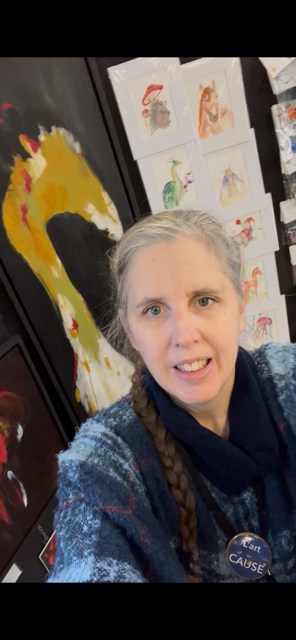
Biography of Rachel Boutin
Rachel Boutin is a multidisciplinary visual artist and consultant for artists. She combines her practice in painting, drawing, and embroidery with professional coaching centered on emotional intelligence and authentic marketing.
Holding a bachelor's degree in art history and certified in EQ-i 2.0, Rachel is the creator of PAC™ (Creative Artistic Journey Profile), an assessment tool specifically designed for visual artists. She exhibited over a dozen times in 2025 and received the Coup de cœur award from art historian Sylvie Coutu at the Festival des arts de Mascouche. She is co-founder of the Art qui cause movement, which combines artistic creation with community engagement.
Rachel has been living with multiple sclerosis since 2008. She works in Repentigny, Quebec.