Top 10 Things to Know About a Person who is Blind
Author: Christopher Barclay
While I do not believe that my blindness completely defines me, it has shaped who I am in significant ways. Living with sight loss affects how I handle various everyday situations, how I communicate with others, and how I view the world (no pun intended).
With that in mind, here are a few things you should know about how I negotiate life with sight loss.
1. When you greet me, remember that I can’t see your face, so I may not recognize who you are at first. Identify yourself clearly, just like you would if you were on the phone or in an online voice chat.
2. While many people with sight loss are often comfortable travelling independently, there are times when a sighted guide comes in handy. For example, travelling in an unfamiliar or crowded space can be tricky for those with sight loss.
If you want to provide sight guidance to me, it’s easy and much appreciated.
a. Introduce or identify yourself, then ask me if I need help.
b. Offer me your arm so that I can then place my hand at your elbow.
c. Walk with me at a comfortable pace with your arm relaxed at your side, allowing me to follow you about half a step behind.
d. Calmly call out any unavoidable obstacles or barriers in our path, such as doors, steps, curbs, etc. Don’t forget to tell me where they are so that I can adjust my steps as needed.
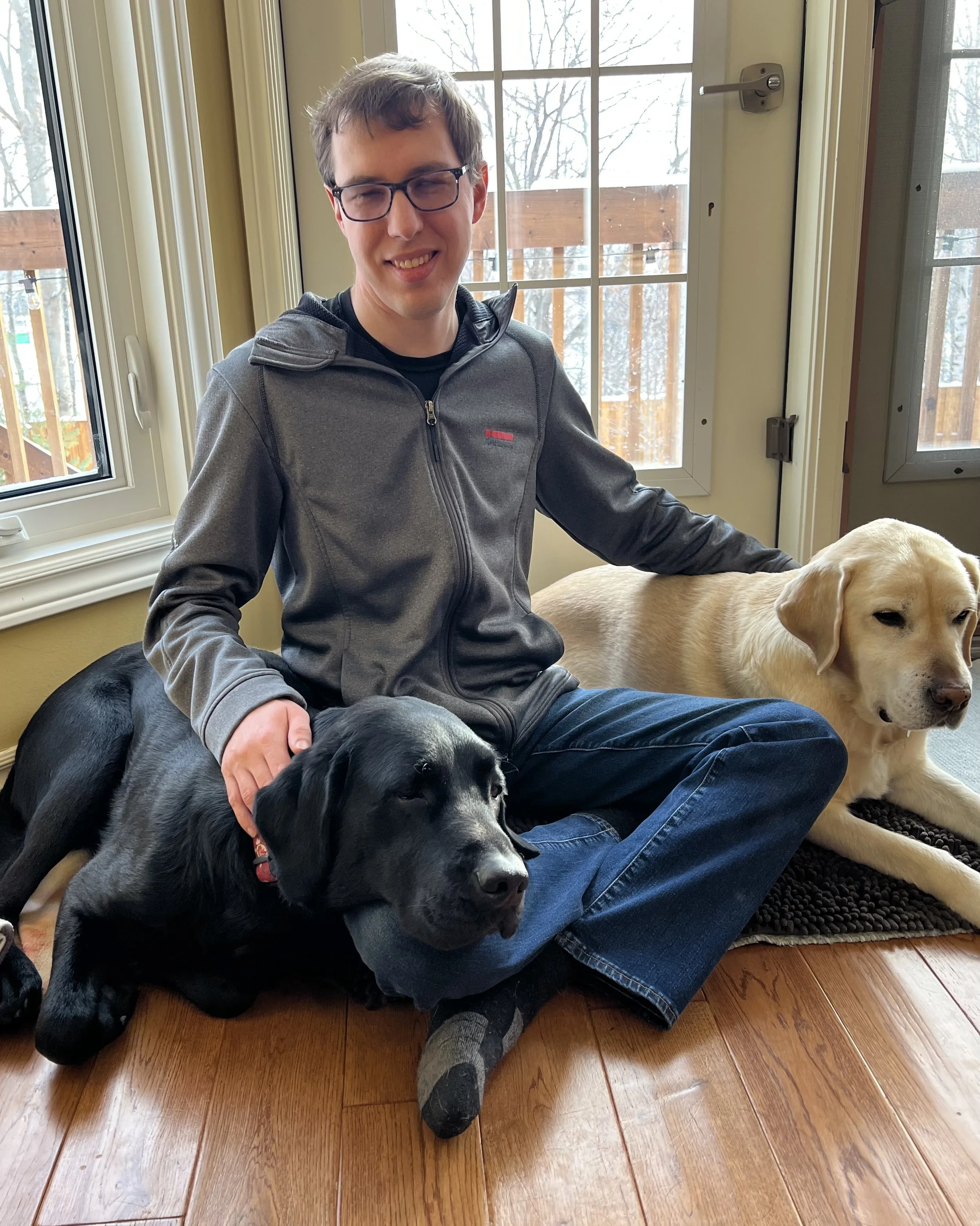
3. I often travel with a guide dog. Depending on the circumstances, my dog can follow you instead of you acting as a sighted guide.
Do not pet or distract my dog while he’s working. My safety depends on my dog’s narrow focus and concentration. Any distractions put both my safety and his safety at risk.
4. When our conversation or interaction is over, be sure to announce when you’re leaving. It’s very awkward and embarrassing to realize that I’m talking to an empty space.
5. If I’ve exchanged contact information with you, don’t be afraid to reach out via text, email, or social media. Contrary to popular belief, people who are blind can and do use the internet. With the help of specialized text-to-speech software, I can listen to the content of an app or a webpage.
6. In a similar vein, I also enjoy watching movies and TV shows. Many “visual” activities like these are made accessible thanks to audio description. This technology consists of an additional audio track that gives a play-by-play of the visual content that’s happening on-screen.
7. While these high-tech solutions have replaced my need for long-form braille content, braille is still useful and relevant in my day-to-day life. It’s a critical tool that helps with essential tasks, from reading the labels on the elevator buttons to knowing if the washroom I’m about to enter is for men, women, or gender neutral.
8. Other sight-loss aids make my surroundings far easier to navigate, such as tactile warning strips at the top of stairs and entrances to crosswalks, or audible signals at intersections with traffic lights.
9. The rise of Artificial Intelligence is becoming the newest and most controversial aid that I use in my day-to-day life. Although AI is far from perfect, I have found that I can maximize its potential by using it in conjunction with the other tools and strategies listed above.
However, AI certainly has its place in my toolkit – most notably helping me recognize items that are impossible to label with braille. AI also assists me with typing on my phone via voice dictation, a task that is very slow using conventional accessibility software.
10. Finally, don’t forget the Golden Rule: Treat me as you wish to be treated – with respect and dignity. People with sight loss are still people, first and foremost.
Christopher Barclay Biography
Christopher Barclay has been a lifelong advocate for greater accessibility. Born with a visual impairment that eventually progressed to total blindness, Christopher first learned to advocate for his own needs including taking STEM courses in the classroom and participating in a wide array of sports and extracurriculars.
These advocacy efforts soon expanded to include the disability community. Throughout high school, Christopher volunteered at summer camps for youth with sight loss and other disabilities. During his undergraduate studies, he was a member of the University of Waterloo’s accessibility student advisory committee. He also excelled in his user-experience (UX) course by applying an accessibility lens to many of the class projects.
For his master’s thesis at the University of Waterloo, Christopher analyzed survey data from a children’s hospital to study the mental wellbeing of children and youth with a variety of disabilities and chronic health conditions. After graduate school, his first job was working as a Product Design Intern on the Accessible and Inclusive Design Team for a large human capital management software company.
Most recently, Christopher has returned to his hometown of Sudbury, Ontario, where he works as the Accessibility for Ontarians with Disabilities Act (AODA) Coordinator for Laurentian University.